







Lastensuojelun sijaishuolto näkyy julkisuudessa usein ongelmien kautta. Siksi tarvitsemme myös toisenlaista puhetta: lastenkodeissa tehdään vaativaa, valvottua ja syvästi inhimillistä työtä,…
Tekijät | Authors

Motivating Sustainability in Companies: A Values-Based Approach
Climate change has emerged as one of the most consequential challenges in documented human history, with recent assessments from the Stockholm Resilience Centre indicating that seven of the thirteen planetary boundaries have already been exceeded. This development underscores a structural tension at the core of contemporary societies: while industrial production remains essential for maintaining prevailing standards of living, it simultaneously contributes substantially to ecological degradation.
Addressing this contradiction requires analytical frameworks that extend beyond technological solutions alone, drawing instead on an understanding of how the values that underpin and shape our organizational everyday life can be mobilized to build organizational responses to sustainability.
The problem with business as usual
We face one of the most pressing concerns in recorded human history: climate change. Today 9 of 13 planetary boundaries have been assessed by the Stockholm resilience centre and seven of them have been crossed. Climate change and biodiversity loss are only a part of the larger equation that constitutes our societies’ impacts on the environment.
It is well established that industrial production is responsible for a significant portion of the emissions and environmental challenges we are facing today. It would be tempting to say that the problem would be easily solved if we decreased production, but decreasing production creates the short-term challenge of lay-offs and unemployment as economic activities would decline. We are trapped in a tension between social, economic, and ecological sustainability, where we expect that promoting one will necessarily disrupt the other.
In short, we need production to maintain our high living standards. At the same time, climate change and other environmental issues require us to decrease our emissions. This is where renewables and circular production comes in. The idea is simply to cut the use of virgin raw materials and maintain a loop between production, used products and secondary raw materials to decrease the need for virgin materials and consequently the environmental impact of production.
Since our economic systems and society are based on the availability of a cheap source of energy (coal, gas, oil) (Urry 2013), a purely technical approach necessarily falls short. Instead, we need to consider how we can adjust our revenue streams and material streams to more efficiently use what has already been mined or produced. To create this kind of change, there needs to be a will for change and a clear direction, a vision.
In our study of basic human values (Schwartz, 1992) and attitudes to sustainability, we attempt to support this transition by identifying ways to make sustainability more attractive for employees by identifying the relationship between sustainability attitudes and values.
Values as drivers of our behaviors
Most healthy individuals have formed immutable principles by which they live. Many hold these unconsciously and they often surface when we are confronted with situations that cross them. They function as points of reference when we make non-routine decisions in our lives, such as choosing our education and jobs (Arieli et al., 2019; Sagiv, 2002). We tend to call these principles “values”. We can describe values as the lenses through which we view and interpret the world around us. What we find desirable, interesting, or important is closely linked to our values (Feather, 1995).
The way that values affect our behavior depends on several things. First the more important the values are, the more likely they will guide our behaviors (Lee et al., 2021). Second, the situation that we interpret must be somehow relevant to our core values, either presenting a threat or opportunity for pursuing our values (Verplanken & Holland, 2002), which then affects our attitudes to the phenomena and consequently how we act in the situation.

Figure 1. A visualization of the values-behavior process. The blue square represents what we identified with the survey and the red square what managers should affect.
Much research shows how different attitudes and particular actions relate to different values (Arieli et al., 2019). We know, for example, that worry about the climate is mainly predicted by biospheric values (e.g. Bouman et al., 2020), represented by the universalism values in the value structure below. Although universalism is an commonly prioritized value, it is less prioritized in the country side and among the more mature population (Lassander, 2017).
These studies only reveal part of how values can be mobilized to engage people in sustainability. Recent research shows that our interpretations of the relationship between situations and values is based on socialization, which means that it can change (Ponizovskiy et al., 2019). So, even if we know that some particular values tend to relate to sustainability and others do not, it is important to understand that it is through the meanings that we attach to sustainability that this link is formed, and those meanings are formed by how we talk about sustainability.
In other words, the way we change people’s attitudes to sustainability needs to build on changing how we talk about sustainability and the meanings we attach to sustainability. Our team is attempting to mobilize this aspect to create values-based ways to engage personnel in sustainability.
A framework for values
In our study we are using the now classical values theory developed by Schwartz (Schwartz et al., 2012). With his method, we can identify 19 basic value types that create a value profile that is illustrated in figure 2. The profile tells us which values are important in a population (e.g. an organization) and which values are less important. The hierarchy of these values is what drives a values-based approach to sustainability leadership, where the point is to make sustainability relevant to the core values in the population, which then provides the foundation for behavioral change.
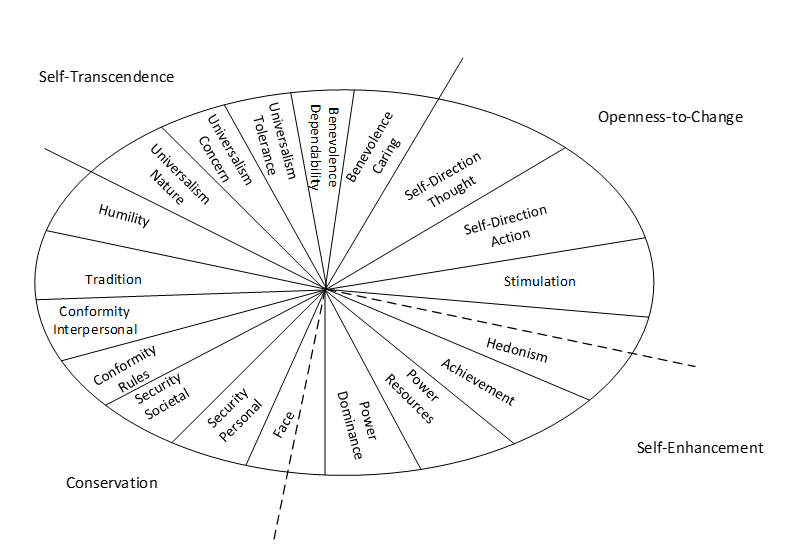
Figure 2. Schwartz’ (2017) value structure.
The model places the nineteen values in two dimensions, openness to change vs. conservation and self-transcendence vs. self-enhancement. These upper-level dimensions describe the shared motivational basis of the values. Where, for example, self-enhancement is more concerned with the self, and the self-transcendence values are more concerned with others. The more adjacent the values are, the more compatible they are, values opposite of each other represent opposing values (e.g. dominance and concern).
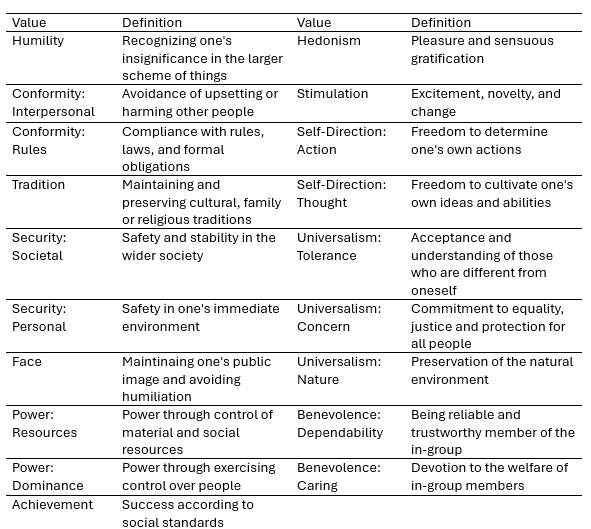
Table 1. Definitions of basic human values (Schwartz, 2017).
What values drive sustainability
We sampled three companies in Rural Finland to research how their employees’ values are related to different aspects of sustainability. Approximately 200 employees responded to the survey, which accounts for about 50% of the population in the units. From the correlational analysis we can discern that there is minor variation in how values correlate with sustainability. Much as in previous research, we can identify the universalism values, in particular their subset “nature” (i.e. biospheric values) to have a positive correlation with both material efficiency (re-use, recycle, minimize material waste) and energy sustainability (saving energy, turning off machines, renewable energy).
Figure two represents the combined mean values of three businesses. The further away from the midpoint the lines are, the more important the value is. The Y shape of the figure indicates that the most prioritized values relate to in-group well-being (i.e. the benevolence values), autonomy (self-direction values), and predictability (societal security).
Figure three, then, visualizes the correlations between each value and two sustainability measures, energy sustainability (e.g. using renewables, energy efficient work practices) and material efficiency (minimizing waste and material use in production).
The challenge is that these two figures do not match. If we consider that values drive our behavior when a situation is considered relevant to them, then the fact that the benevolence values (that we prioritize) do not correlate with sustainability may be why we are not particularly engaged in driving sustainability. It does not resonate with our core values.
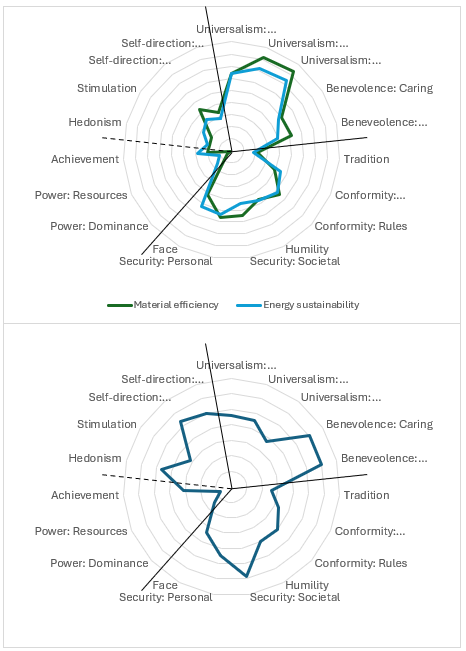
Figure 3. The correlations between values and attitudes to material efficiency and energy sustainability (upper) and the sample value profile (lower).
What can we do about it?
When discussing our survey results with practitioners, some things pop-up. First, company representatives have identified themselves in the results and tend to reflect on situations where they can identify elements of their profiles. This can relate to individual cases or attitudes that they have identified in their respective organizations, which has cast light on what role values can have in leading sustainability and in which ways we could consider the company value profiles when addressing sustainability. Here are some examples:
Community well-being and reliability. The most emphasized values in our sample are the benevolence values. They relate to the importance of the well-being of one’s family, friends, colleagues, and people that one can identify with or relate to (i.e. one’s “in-group”) and being a reliable member of that in-group. An individual can, of course, relate to several in-groups such as soccer teams, family, hockey teams, units, organizations, regions, the point is that the concern for well-being is confined by identification, and is not universal.
How does this relate to sustainability? It does not by default, as we can see in figure 3, and that is the problem. However, framing sustainability in terms of local benefits is an approach that could increase the general interest in sustainability. We have mainly focused on circularity, which often relies on local sub-supplier and sub-contractor networks, so increasing the circularity of production would not only mean decreased emissions, but also increased local economic activities, which translates to jobs and welfare. Benefits that can be linked to the benevolence values.
Autonomy. Much of the discussions revolve around creating opportunities for staff to be involved in ideating and implementing sustainability initiatives. This creates an important link to the self-direction values and makes sustainability initiatives a place where autonomy is realized, rather than something required top-down by management, EU, or a national institutions. What is important is to avoid situations where management simply orders employees to start working in a new way without providing context or opportunity to participate in defining the new ways of working.
Predictability. Even though sustainability initiatives often disrupt current ways of working, it also produces stability in the long-term. There are several ways in which management can consider the need for predictability inferred by the high priority of societal security. We can consider this at several levels. On the macro level, we don’t really know what will happen to our societies if we disregard the environmental impacts of our activities. On the corporate level, having an additional revenue stream through servicing, remanufacturing or refurbishing creates a continuum of revenue even when new product demand is low. The examples above are basically the why’s related to predictability, the how’s build on creating a transparent process and investing in communicating the steps for the change process whether it’s related to sustainability or something else.
Hedonism. Sustainability is easily perceived as a layer of bureaucracy on top of the “real work” that needs to be done. Hedonism is also one of the few values that are somewhat emphasized in our study and relates negatively to sustainability. While we are not able to discern why this is the case, it is likely related to perceiving sustainability as something that makes work more cumbersome. The key question related to this value is how the initiatives can be made less bureaucracy-driven and more related to development work and how the work can be made as effortless as possible.
Johnny Långstedt
Researcher, Entrepreneurship and Value-Creation, TurkuAMK.
Title of Docent in New technology and cultural change, Åbo Akademi.
References
Arieli, S., Sagiv, L., & Roccas, S. (2019). Values at Work: The Impact of Personal Values in Organizations. Applied Psychology, accepted author manuscript. https://doi.org/10.1111/apps.12181
Bouman, T., Verschoor, M., Albers, C. J., Böhm, G., Fisher, S. D., Poortinga, W., Whitmarsh, L., & Steg, L. (2020). When worry about climate change leads to climate action: How values, worry and personal responsibility relate to various climate actions. Global Environmental Change, 62(April), 102061. https://doi.org/10.1016/j.gloenvcha.2020.102061
Feather, N. T. (1995). Values, Valences, and Choice: The Influence of Values on the Perceived Attractiveness and Choice of Alternatives. Journal of Personality and Social Psychology, 68(6), 1135–1151. https://doi.org/10.1037/0022-3514.68.6.1135
Lassander, M. (2017). Arvojen Kamppailu ja Uusi Maailmanjärjestys – Suomi Vuoden 2015 Jälkeen. Niin & Näin, 2017(1), 31–41.
Lee, J. A., Bardi, A., Gerrans, P., Sneddon, J., van Herk, H., Evers, U., & Schwartz, S. (2021). Are Value-Behavior Relations Stronger than Previously Thought? It depends on value importance. European Journal of Personality, online fir. https://doi.org/10.1177/08902070211002965
Ponizovskiy, V., Grigoryan, L., Kühnen, U., & Boehnke, K. (2019). Social construction of the value-behavior relation. Frontiers in Psychology, 10(APR). https://doi.org/10.3389/fpsyg.2019.00934
Sagiv, L. (2002). Vocational interests and basic values. Journal of Career Assessment, 10(2), 233–257. https://doi.org/10.1177/1069072702010002007
Schwartz, S. H. (2017). The refined theory of basic values. In S. Roccas & L. Sagiv (Eds.), Values and Behavior: Taking a Cross-Cultural Perspective (pp. 51–72). Springer.
Schwartz, S. H., Cieciuch, J., Vecchione, M., Davidov, E., Fischer, R., Beierlein, C., Ramos, A., Verkasalo, M., Lönnqvist, J.-E. E., Demirutku, K., Dirilen-Gumus, O., & Konty, M. (2012). Refining the theory of basic individual values. Journal of Personality and Social Psychology, 103(4), 663–688. https://doi.org/10.1037/a0029393
Verplanken, B., & Holland, R. W. (2002). Motivated decision making: Effects of activation and self-centrality of values on choices and behavior. Journal of Personality and Social Psychology, 82(3), 434–447. https://doi.org/10.1037/0022-3514.82.3.434
Artikkeli on osa Yrittäjyys ja arvonluonti -tutkimusryhmän julkaisuja.