







Tekoäly (AI) on tullut jäädäkseen myös B2B-myyntiin. Silti sen tuoma hyöty ei synny yksittäisistä työkaluista tai käyttöönottoprojekteista. Turun ammattikorkeakoulun Myynti…
Tekijät | Authors
Current Challenges in B2B-Sales according to a multinational Study
Sales poses different challenges and these become more pronounced in international contexts. This study examines challenges encountered across various European countries.
The world of marketing and sales is rapidly changing, be it because of social media, Artificial Intelligence (AI) tools being introduced, or the rise of online sales meetings instead of in-person meetings. Especially the introduction of AI in sales has the potential to massively influence sales as the literature analysis of (Fischer et al., 2023) has shown. As technology advances, companies will need not only to keep up with new trends but also adjust their marketing and selling strategies accordingly (Au & Yeung, 2007; Jones et al., 2005; Corsaro & Maggioni, 2022). At the same time, competition is becoming increasingly fierce as buyers have access to a wide range of options when making purchasing decisions (Paesbrugghe et al., 2018).
Multinational study highlights European differences
Previous research on attitudes toward challenges faced in the future roles of sales professionals has focused on one or a few countries or a specific change in technology. In this study, it was decided to study the phenomenon more comprehensively from a global perspective without being limited to any predetermined change.
Challenges in Sales
To investigate challenges in sales, a multinational study with 1,247 salespersons and sales managers within 21 countries was conducted in the form of questionnaire. Data was collected between 2020 and 2022. After collecting the data, a content analysis to code the data and later derive clusters of similar statements was applied.
A chi-square goodness-of-fit test was performed, and a bootstrapping procedure was conducted. Based on this, the clusters were formed to be Digitalization (286), Competitive Forces (158), Innovation and Technology (158), Competencies (150), Customer-centric (128), Impersonal (121) and Economy (112). The number of correspondents are highlighted in brackets.
How does Europe differ?
When reviewing the results, the concerns related to the clusters seemed to be independent of the work experience, education, or management level of the respondents. Although country differences were found as seen from Table 1 below.
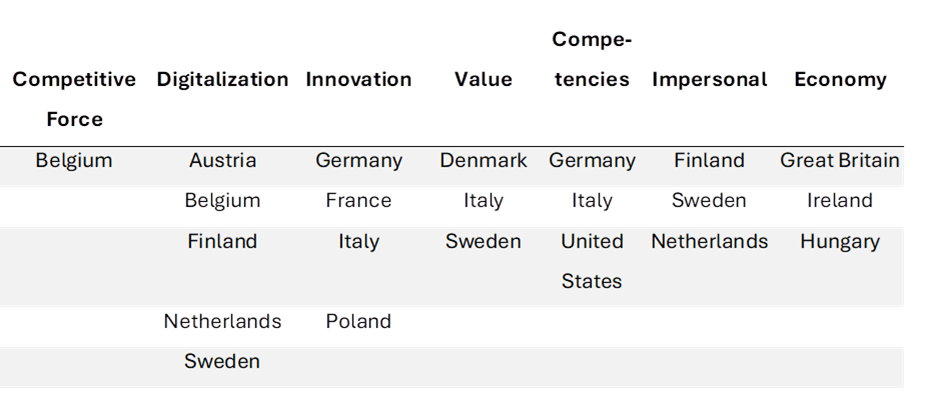
Table 1. Country differences related to Challenges in B2B-SalesAs seen from Table 1., digitalization was the number one challenge mentioned within Austria, Belgium, Finland, Netherlands and Sweden. This finding together with the entries on sales becoming more impersonal indicates that personal communication seems to be particularly important in these countries when establishing and maintaining customer relationships. Managers should keep this in mind when they interact within these countries and aim at setting up sales strategies that carry the risk of having less contact with customers. This could mean adjusting the strategy accordingly or addressing underlying fears and finding a solution that takes that into account.
Digitalization was the number one challenge mentioned
To cope with these changes, organizations must develop their digital sales because companies with fully developed digital sales capabilities are more competitive (Schürmann et al., 2017). However, it is clear from past studies that a shift to a more digitalized sales function produces insecurities in salespeople that managers must address (Sharma et al., 2010), as was mentioned by the challenges of sales becoming more impersonal.
The respondents from Germany, Italy and the US most often mentioned the challenge to adjust the sales competencies. This seems to highlight the challenge in developing competencies. There might be a need for coaching, training or even skill assessment.
When considering sales becoming more impersonal, or something that is not connected to personal feelings, identity, or individual characteristics. like online meetings, participants from Finland, Sweden and Netherlands mentioned this more often.
Sales is personal and cultural dependent
Only respondents from Denmark, Italy and Sweden see the value and value creation to be a challenge in B2B-Sales. At the same time, Germany, France, Italy and Poland feel that innovation in sales can be seen as a challenge in B2B-Sales. The responses from Belgium saw competitive force to be a challenge.
At the time of the study, only respondents from Great Britain, Ireland and Hungary were concerned about the economy. This can be partly explained by Brexit and its aftermath. If the study would be conducted today, the results could be different.
Managerial implications
Managers should not only focus on the single challenges set out in this article and consider them when drafting strategies or launching initiatives for addressing changes. It is also essential to analyze how the various challenges might be interrelated. As outlined above, digitalization is driven by innovation and technological advances. This process might lead to less face-to-face contact, for which companies must prepare.
This development also means assessing what type of competencies are needed to be able to deal with these challenges. Developing digital competencies enables salespeople to access a considerable amount of information about their product offerings and customers and tailor their offers to the specific needs of their customers.
Conclusion
Sales is challenging. Especially international sales within Europe. Sales is always personal and cultural dependent, as seen from this study. Based on the results, it may be a good idea to address the implication your offer may have on the competitiveness more often in Belgium or and to focus more on digital solution possibilities in Austria. In Finland, Sweden and the Netherlands, when addressing digitalization solution possibilities, implications for a more impersonal sales process may have to be taken into account more likely. Focusing on innovational aspects would be more important in Germany, France, Italy and Poland
Indeed, sales is culturally dependent.
References
Au, A.K.M. and Yeung, M.C.H. (2007) Selling technology to Hong Kong manufacturers: an empirical extension of the technology acceptance model, International Journal of Technology Marketing, Vol. 2, No. 3, pp.201–224.
Corsaro, D. and Maggioni, I. (2022) Sales transformation: conceptual domain and dimensions, Journal of Business & Industrial Marketing, Vol. 37, No. 3, pp.686–703.
Fischer, H., Seidenstricker, S. and Poeppelbuss, J. (2023) The triggers and consequences of digital sales: a systematic literature review, Journal of Personal Selling & Sales Management, Vol. 43, No. 1, pp.5–23.
Jones, E., Brown, S., Zoltner, A. and Weitz, B. (2005) The changing environment of selling and sales management, Journal of Personal Selling & Sales Management, Vol. 25, No. 2, pp.105–111.
Paesbrugghe, B., Sharma, A., Rangarajan, D. and Syam, N. (2018) Personal selling and the purchasing function: where do we go from here?, Journal of Personal Selling & Sales Management, Vol. 38, No. 1, pp.123–143.
Schürmann, J., Schmitz, C., Taneja, V., Andersen, P., Mustaghni, B. and Wieseke, J. (2017) Bringing yur digital B2B sales up to speed [online] https://www.bcg.com/publications/2017/channel-transformation-marketing-bringing-your-digital-b2b-sales-up-speed (accessed18 March 2025).
Sharma, D., Gassenheimer, J.B. and Alford, B.L. (2010) Internet channel and cannibalization: an empirical assessment of sales agents’ perspective, Journal of Personal Selling & Sales Management, Vol. 30, No. 3, pp.209–221.
Full version oft he article has been published at: Berger, T., Holopainen, T., Korpela, P. and von Wowern, P. (2025) `Challenges in sales: a multinational study`, The International Journal of Technology Marketing, Vol.19, No.4, pp. 387 – 402.
Artikkeli on osa Myynti ja B2B-liiketoiminta -tutkimusryhmän julkaisuja.