





Voiko teknologia tietää mitä ihminen haluaa? Biometriikan avulla opimme jatkuvasti enemmän siitä, miten tunteet, tarkkaavaisuus ja päätöksenteko näkyvät käyttäytymisessämme. Entä…
Tekijät | Authors
Beyond Words and Behaviour: Using Biometric Feedback Responsibly in Sales Training
A customer questions a salesperson’s credibility, rejects a price proposal or demands an immediate guarantee. The salesperson must listen, think and respond within seconds. They can observe words and behaviour, but not the physiological activation accompanying the exchange. Should sales education pay attention to this invisible dimension?
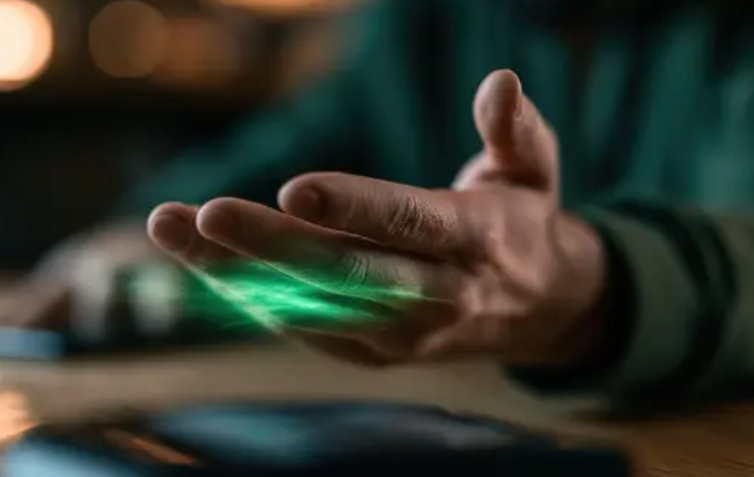
Galvanic Skin Response (GSR) records changes in skin conductance related to sweat gland activity controlled by the sympathetic nervous system (Boucsein, 2012). The signal can indicate physiological arousal, but not its emotional meaning. An increase might accompany tension, attention, excitement or several processes at once.
What if the most important reaction is invisible?
That distinction is fundamental. A salesperson showing elevated skin conductance is not necessarily struggling; a calm-looking signal does not prove effective communication. Skin conductance cannot diagnose confidence, resilience or sales competence. Movement, temperature, individual differences and the timing of responses also complicate interpretation (Boucsein et al., 2012).
The learning theory behind physiological feedback
Self-regulated learning provides one rationale for using physiological information. Zimmerman (2002) describes learners as active participants who monitor and adapt their thoughts, actions and motivation. In a sales simulation, a student might recognize a tendency to defend a proposal too quickly after an objection and decide to ask a clarifying question instead.
Experiential learning provides a second rationale. Kolb (1984) connects concrete experience, reflection, conceptualization and experimentation. A simulated negotiation offers the experience; reviewing a video and GSR trace can prompt reflection; the student then tests a different response in a later conversation.
Neither theory suggests that adding a sensor automatically improves learning. The educational mechanism is the quality of the reflection: What happened? How did the student interpret the situation? Which response served the customer relationship? What could be tried next?
A potential model for B2B sales education
A practical learning sequence could combine four elements: a realistic customer interaction; synchronized video and physiological recording; a guided debrief based on selected moments; and a second simulation to test an alternative approach. Educators can replay a negotiation, review what was said, and invite students to reflect on their perceived challenge and chosen response.
The educational opportunity lies in guided debriefing. Educators can replay a negotiation, review what was said, and invite students to reflect on their perceived challenge and chosen response. GSR adds a physiological perspective without replacing behavioural feedback or the learner’s account.
Biometric feedback does not replace behavioural feedback
At the University of Applied Sciences Wiener Neustadt (FHWN), Austria, Shimmer GSR sensors and iMotions software have been used during B2B sales simulations in the Science Lab. The same method and similar equipment have been utilized in Turku University of Applied Sciences (Turku UAS) as a negotiation exercise for both Bachelor and Master level students. This pedagogical approach has also been applied in several Armenian and Georgian Universities as a part of an EU funded Erasmus plus project Learn – Innovate – Sell – Succeed 2024.
Reflective learning oppotunity
Biometric feedback creates risks alongside opportunities. Students might perceive physiological activation as failure or feel pressure to appear “calm”. Educators could mistake an attractive graph for an objective score. Such interpretations would undermine the reflective purpose of the exercise.
Responsible design therefore requires voluntary participation, informed consent, limited data access, appropriate retention rules and a clear separation between reflective feedback and grading. Physiological data should be interpreted together with observed behaviour and the student’s account, not used to rank individuals.
More data does not necessarily mean better education
The debate is not whether sales educators can measure physiological arousal. They can. The more important question is whether those measurements help students understand their responses, make better decisions and communicate more effectively under pressure.
The next research step could be to test whether combining video, physiological feedback and structured reflection improves self-awareness or communication compared with conventional sales training.
References
Boucsein, W. (2012). Electrodermal activity (2nd ed.). Springer. https://doi.org/10.1007/978-1-4614-1126-0
Boucsein, W., Fowles, D. C., Grimnes, S., Ben-Shakhar, G., Roth, W. T., Dawson, M. E., & Filion, D. L. (2012). Publication recommendations for electrodermal measurements. Psychophysiology, 49(8), 1017–1034. https://doi.org/10.1111/j.1469-8986.2012.01384.x
Kolb, D. A. (1984). Experiential learning: Experience as the source of learning and development. Prentice Hall.
Zimmerman, B. J. (2002). Becoming a self-regulated learner: An overview. Theory Into Practice, 41(2), 64–70. https://doi.org/10.1207/s15430421tip4102_2
Boxi
This work is part of EU funded the Erasmus+ Project LISS24 (Learn-Innovate-Sell-Succeed). Views and opinions expressed are however those of the author(s) only and do not necessarily reflect those of the European Union.
More on the project www.liss24.com
The article is part of the publications of the Sales and B2B Business research group.
Picture: Adobe Stock (Education License)