







Climate change has emerged as one of the most consequential challenges in documented human history, with recent assessments from the…
Tekijät | Authors
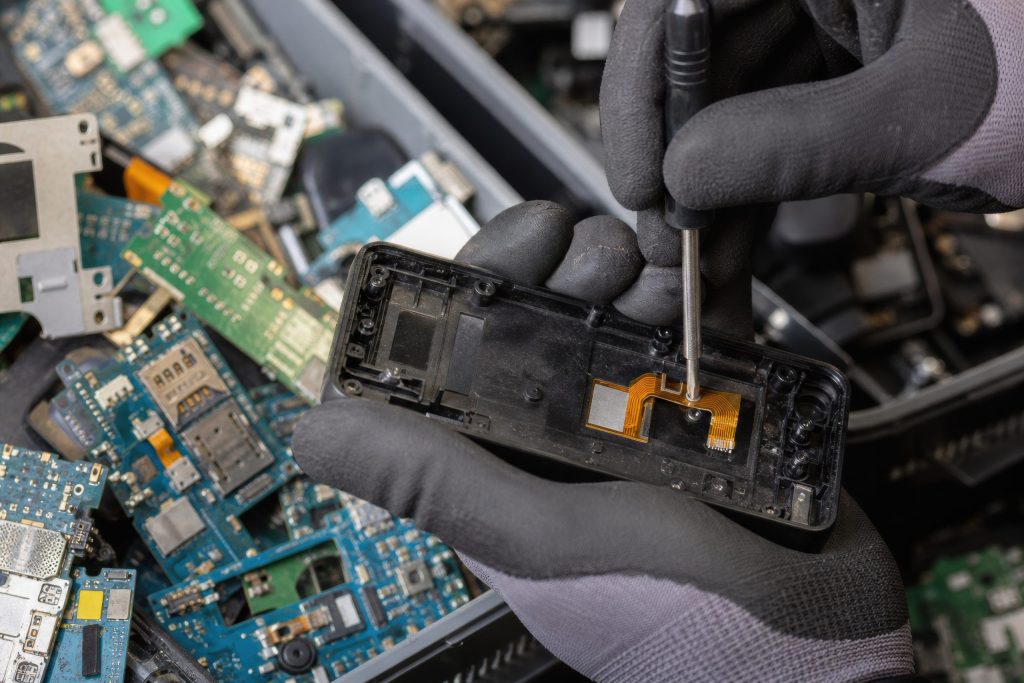
What motivates consumption of remanufactured electronics?
A challenge in building a sustainable business is convincing consumers and customers that refurbished or remanufactured products are as good and desirable as new products. In this short article we provide a glimpse into the non-rational foundations of beliefs about remanufactured products. We show how attitudes to remanufactured products are connected to a broader set of basic values in an international sample of students.
In the face of climate change and environmental degradation, efforts have been made to increase the circulation of raw materials. In public discourse a common way to portray this is to claim more effective waste management, recycling processes, or increasing the share of renewable energy production. However, calculations of raw material use, and recycling efficiency provide strong evidence that recycling is an insufficient strategy to offset our raw material usage (Bocken, 2024).
Remanufacturing has, in many industries, including consumer electronics, become a profitable business model. Remanufactured products can save up to 80% of materials and associated costs, providing a business case for products that are renewed before their end of life (e.g. www.remanufacturing.eu). For customers, remanufacturing creates an opportunity to procure products with as good performance as virgin products at a lower cost. For producers of remanufactured products, this creates an opportunity to enter new markets and reach new customer segments.
What is often overlooked in the technology-driven discourse is that consumption is affected by our identities and our attitudes. For example, our clothing and the products we use are ways through which we signal to others who we are, or a means to affect how we want people to perceive us. Our values, fundamental beliefs about what is important to us, are closely linked to our identities and attitudes (e.g. Verplanken & Holland, 2002), making them a particularly interesting starting point for studying consumer attitudes to remanufactured products.
In conjunction with the SuFiRe research project, which examines values-based sustainability management, circular business models, and environmental regulation, we initiated a study of business students (N= 270) in Sweden (n=73), Finland (n=93), and Hungary (n=104) to identify how and which values affect attitudes to remanufactured products.
We consider five different factors that could affect the decision to purchase remanufactured products:
- First, people might find it disgusting to use electronics that have been previously used: they might have contamination concerns.
- Second, the environmental benefits of purchasing remanufactured products can affect the choice significantly.
- Third, the respondent might be concerned about how they appear in others’ eyes if they purchase used products: a status concern may arise.
- Fourth, remanufactured products may be viewed as having inferior quality or hidden defects, which can lead to quality concerns.
- The fifth identified factor is the economic benefits of remanufactured products combined with the trustworthiness of their suppliers.
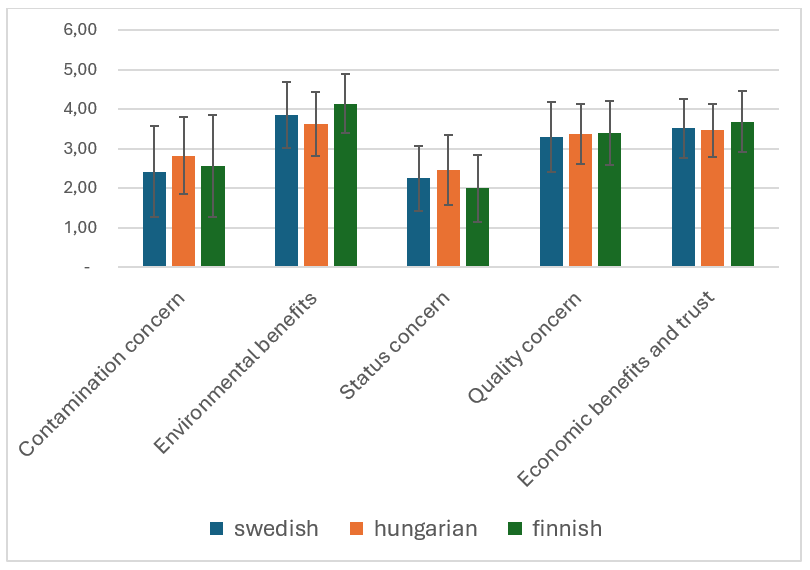
Figure 1. Mean scores of attitudes to remanufactured products.
Our statistical comparison of the sample means from the three countries and the five factors indicate that attitudes do not differ significantly regarding the economic benefits and quality concern across the country samples. Statistically significant differences were identified between Hungarian and Swedish students regarding contamination concern (MD = -.41, p = .04) and regarding status concern (MD = -.47, p < .001) and environmental benefits (MD = .51, p < .001) between the Finnish and Hungarian students.
The results suggest some country-level differences, however, after accounting for values, the data shows that there are only significant differences between the Hungarian and Finnish students regarding environmental benefits of remanufactured products (t(2, 257) = 5.04, p = .01). This suggests that values, rather than nationality, are the primary elements for most factors related to remanufacturing that we considered in the study.
However, values are shaped by the contexts that people grow up in, and value differences between countries can explain attitude differences between the Hungarian, Swedish, and Finnish students. To consider the value differences between the samples, we measured the mean difference between the samples and their statistical significance. The means are depicted in Figure 2. Higher bars mean a stronger emphasis on the value and lower bars a weaker emphasis on the value.
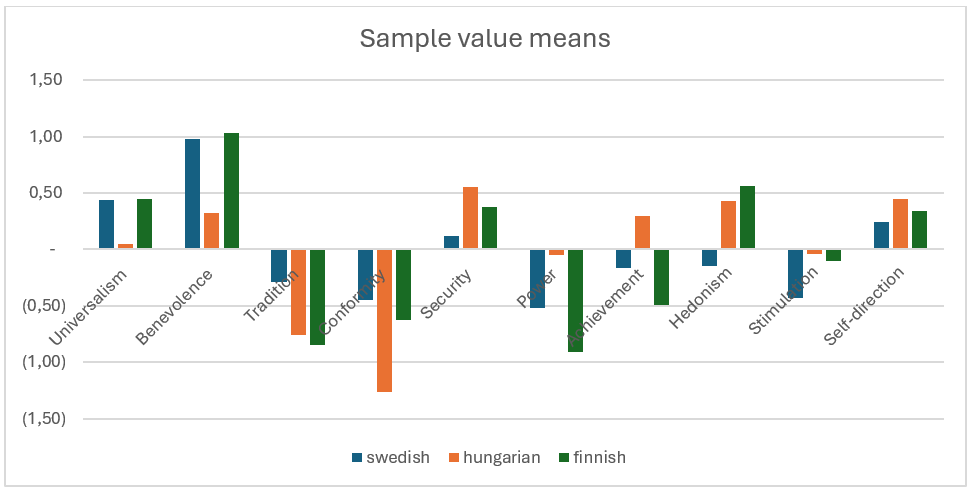
Figure 2. Centered mean scores of values by country.
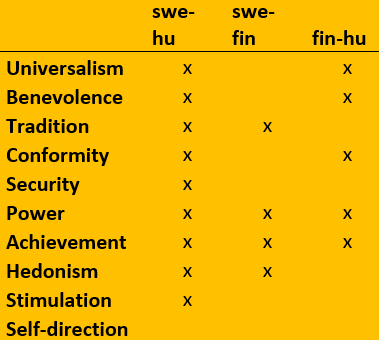
Table 1. x = statistically significant difference (p < .05), swe = Swedish, hu = Hungarian, fin = Finnish
While values overrode nationality as a determinant of most beliefs about remanufactured products, they also differ across the samples. As we can see from the figures, there are similarities between the countries and differences in terms of values. Table 1 describes the statistical differences between the samples, and the size of that difference is easily identified from Figure 2.
For example, there are no statistically significant differences in self-direction across the samples, which means that we cannot rule out reliably enough that the differences visible in the means would translate into a “real” difference rather than a result from sampling or statistical noise. The power value, in contrast, illustrates a statistically significant difference between all samples. In other words, we can say reliably enough that it is unlikely that we have a false positive.
Which values are relevant?
Now that we are aware of the differences in the samples and have concluded that there are value and attitude differences between the samples and that values, rather than “nationality”, drive those attitudes, the main question becomes: which values are relevant? For this we used a standard correlational analysis.
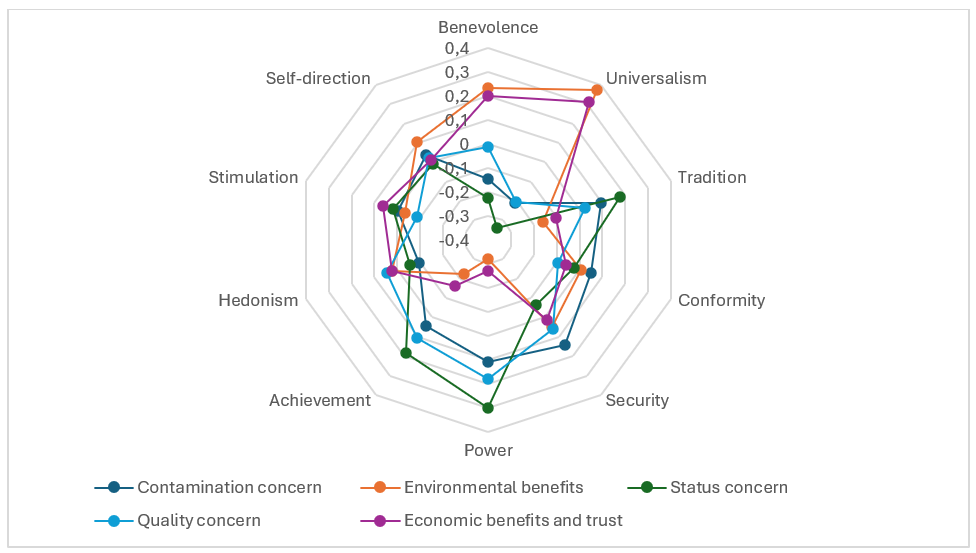
Figure 3. Correlations between basic values and views on remanufactured products.
From the figure above, we can discern the correlations between each value and the remanufacturing factors. It becomes quite clear that the altruistic (benevolence) and socio-biospheric values (universalism) are connected to stronger beliefs about the positive environmental benefits and lesser concerns about the features of remanufactured products. In contrast, egoistic values indicate a stronger concern about status implications and lower trust in the economic and environmental benefits of remanufactured products.
What about people’s concerns about climate change?
Because climate concern may affect the relationship between values and attitudes toward remanufactured products, we included an item regarding climate concern in the survey. This way we could discern the impact that concern about the climate could have independently on attitudes to remanufactured products and how it might affect the relationship between values and attitudes to remanufactured products.
The correlations between egoistic, altruistic, and socio-biospheric values and the remanufacturing factors maintained the same direction when controlling for climate concern. However, the self-direction values’ correlation increased and became statistically significant when controlling for climate concern. This means that the relationship between the self-direction value and the environmental benefits of remanufactured products is dependent on the level of concern about climate change. In other words, when people are concerned about climate change, even self-direction contributes to positive attitudes to remanufactured products.
Where do we get from here?
Our emissions are driven by an economic system that relies on the consumption of goods as manufacturing and service jobs are dependent on consumer demand. Remanufactured products provide a lower-emission option for consumers. There are, however, concerns and images of remanufactured products that must be overcome for them to become the primary option for consumers. From our study we found that the concerns are similar across the samples, but the Hungarian and Finnish samples differ in relation to the beliefs about the environmental benefits of remanufactured products. Finnish students expressed stronger beliefs in the environmental benefits of remanufactured products.
The practical take-aways from the study are twofold. First, the attractiveness of remanufactured products to people that appreciate nature is already established, broadening the range of values with which remanufacturing resonates has considerable potential. Second, comparing the mean values and the correlations reveals, for example, because the security values are more pronounced in Hungary, it may be more effective to frame remanufactured products in terms of security than altruistic or biospheric benefits (which would work better in the Nordics). Finally, the results showcase why consumers may divert from remanufactured products and provide information on which priorities are linked to negative beliefs about remanufactured products and how the products should be framed to overcome those beliefs.
The results clearly show that people with strong socio-biospheric values are more positive to remanufactured products than those to whom egoistic values are important.
Importantly, we found that across the samples, values, rather than nationality, were the dominant predictors of attitudes to remanufactured products. This provides a promising basis for marketing and for forming attitudes to less emitting consumption across Europe. We now know that altruistic and socio-biospheric values provide a strong basis for more sustainable consumption.
The results clearly show that people with strong socio-biospheric values are more positive to remanufactured products than those to whom egoistic values are important. Promoting consumption of remanufactured products would benefit from marketing the products in a more diverse way than as sustainable products. Especially in areas where the socio-biospheric values are lower, such as in the Hungarian sample, tapping into other values is likely to be a more efficient way to promote remanufactured products. Such values could be hedonism or security, for example. The altruistic and socio-biospheric values are unlikely to resonate in the population.
Our results also suggest that the positive and negative beliefs about remanufactured products are strongly tied to our values, which suggests that they are more based on gut feelings than on accurate knowledge. The meanings associated with remanufactured products are therefore important to reframe to better fit the value profiles of the target consumers, sustainability is unlikely to be an effective or universal driver of green consumption.
Limitations
For this research, we sampled students and this often creates an overlooked, but relevant limitation to a study’s results. While the obvious limitation is the lack of a representative sample (we cannot definitely know, if the results translate to the population), another issue is that students tend to be from a more affluent societal class, which, while not necessary skewing the results, at least overlooks a significant portion of the population.
References
Bocken, N. M. P. (2024). Circular Business Model Innovation: New Avenues and Game Changers. In Business Model Innovation Game Changers and Contemporary Issues. Palgrave Macmillan.
Verplanken, B., & Holland, R. W. (2002). Motivated decision making: Effects of activation and self-centrality of values on choices and behavior. Journal of Personality and Social Psychology, 82(3), 434–447. https://doi.org/10.1037/0022-3514.82.3.434
The article is part of the publications of the Entrepreneurship and Value Creation research group.
Main image: Adobe Stock (Education License), Generated with AI
Other pictures: SuFiRe project