





Vaikka digitaalisen murroksen vaikutukset ja erityisesti tekoälyyn liittyvät näkökulmat tuntuvat ajankohtaisilta, ei aihe sinänsä ole uusi, sillä sitä on käsitelty…
Tekijät | Authors
Exhibiting and presence in the digital age: Possibilities of the hybrid exhibition in the Professional Media Presence project
Although the impacts of digital transformation, and particularly perspectives relating to artificial intelligence, seem highly topical, the subject itself is not new, as it has been discussed in art theory for decades (Bentkowska-Kafel, 2015). Naturally, the digital transformation also gives rise to critical perspectives: it has been argued that digitalisation challenges the democratic social order (Kraynak, 2020), whilst other viewpoints suggest that digitalisation, as a tool, democratises, for example, access to art (e.g. An, 2024; Huang, 2023). This article examines the structures of an artist’s visibility and digitalisation from the perspective of exhibition practice, which will be explored in the context of an international, Creative Europe-funded project as part of a multidisciplinary and international hybrid exhibition programme to be held in autumn 2026.
The aim of the Professional Media Presence project is to strengthen the identity and presence of artists from diverse backgrounds in digital media, while also taking into account the transformation of traditional media. The content of the Professional Media Presence project is structured around five themes:
- Media & Art
- Online Media & Digital Storytelling
- Social Media & Media Readership
- Future Media
- Media and Professional Identity
These themes examine the artist’s role in a changing media environment from various perspectives, ranging from the relationship between media and art to digital storytelling, social media audiences and future media. The project’s themes explore the possibilities of the artist’s digital presence, as well as how artists can build and develop their professional identity and visibility within a changing media and operational environment.
The exhibition as a space for presentation and experimentation
The exhibition, which will take place in the final phase of the project, will be presented in a hybrid format and will include physical exhibitions in Turku, Tornio, Barcelona, Valletta, Split, Trnava and Venice, a performance tour in Italy, and a joint virtual exhibition. The more than one hundred artists involved in the project have had the opportunity to propose works for inclusion in both the physical exhibition in their own region and the virtual exhibition. The series of physical exhibitions, together with the virtual exhibition, forms a unique whole and a collection of artistic content and performances.
The project’s artists represent a wide range of art forms: media art, dance, literary art, performance art, body art and tattoo art, photographic art, visual art, film, illustration, music, design and architecture. This multidisciplinary approach also creates interesting opportunities and challenges for both physical and virtual forms of presentation. The practices of presenting different art forms vary, and when presented side by side, they open up the opportunity to examine how different artistic forms construct meaning, experience and presence in various spatial environments.
The exhibition is a central part of the project’s dissemination of results, but at the same time it serves as a platform for experimenting with and developing artistic content and modes of expression. Artists are involved in the realisation of the exhibition in various ways: for example, the exhibition by the National Artist Team at Art Academy of the Turku University of Applied Sciences is being curated collectively by a working group. Each partner in the project has the opportunity to organise an exhibition based on their own perspectives, which also facilitates artist-led thinking and highlights regionally significant viewpoints.
Forms and materialities of encounter
Material and materiality can be approached as an active component in the process of constructing a hybrid exhibition: how does the materiality of a work transform in relation to physical and virtual spaces? How are works experienced, perceived, approached and explored in physical and virtual spaces? From the perspective of the exhibition as a whole, it is interesting to consider how the audience participates in and is invited to become part of the experiential nature of the works in various material and non-material spaces.
According to López-Rodríguez et al. (2025), there are various, and at times conflicting, perspectives on virtual exhibitions and the fusion of art and technology. Digital environments can be seen as distancing viewers from the materiality of the works, but on the other hand, they can also be viewed as enabling deeply immersive and multisensory experiences. This debate also raises the question of the extent to which a technologically mediated experience can directly influence the viewer’s interpretation of the artworks.
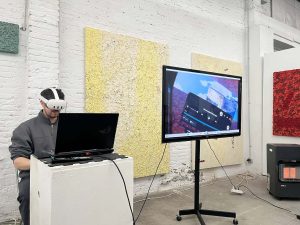
In the “Forms of Presence” exhibition series of the Professional Media Presence project, different modes of engagement coexist. The virtual exhibition comprises seven distinct exhibition spaces, which can be explored via mobile devices, a web browser or virtual reality headsets. Each exhibition space – a virtual room – forms its own distinct entity within the overall exhibition.
Some of the works in the virtual exhibition have been digitised from physical artworks, whilst others were originally created for digital platforms. The exhibition also features works created in collaboration during the project, such as the video work Float by Leda Vaneva (Finland/Turku University of Applied Sciences), Edo Garcia (Spain/Espronceda) and Sari Sandberg (Finland/Lapland University of Applied Sciences). The virtual exhibition does not merely serve as a documentation of the physical exhibitions; rather, it forges its own connections between the works. On the other hand, when a work that already exists in the physical world is digitised and placed in a different context and material reality, it is encountered, interpreted and experienced as a distinct work in its own right, from different perspectives. In a digital environment, for example, works located in different countries can encounter one another in a way that would not be possible in a single physical exhibition space.
It is crucial to consider what kinds of forms of encounter can be constructed around the works in a hybrid exhibition. In a traditional exhibition, the encounter often takes place in a physical space within the relationship between the work, the space and the viewer. In a virtual environment, the conditions for encounter and experience change in relation to the material reality of the works. Experiencing the works allows for repetition, variations in scale and duration that are not bound by the constraints of the real world. On the other hand, physical exhibitions offer the opportunity for a material experience, spatial interaction and communal encounters that cannot be fully – at least not in their current form – transferred to a digital environment.
The realisation of an exhibition raises questions not only about the presentation of the works but also about curation, collaboration and the sharing of information. How is an exhibition structured when the participants are working in different countries and cultural contexts? How is a shared exhibition identity formed in a situation where each partner has their own starting points and priorities? And how can the digital environment function as a shared space that connects exhibitions geographically separated from one another?
The hybrid exhibition consists of multiple, parallel experiences. Rather than positioning the digital and physical exhibitions in opposition to one another, they can be viewed in terms of the new meanings that emerge through the dialogue between them.
Digitalisation as a tool for visibility and accessibility
An artist’s visibility today is increasingly built on the requirement to operate simultaneously across multiple environments. Exhibitions, websites, visibility on social media, and other digital footprints form a whole through which artistic work may be seen and discovered. A digital presence is not a separate part of an artist’s practice, but rather one of the fundamental prerequisites for artistic activity. From the perspective of the individual artist, challenges arise from the constantly changing media landscape, ethical issues related to the use of social media platforms managed by large technology companies, and the fact that, at least for the time being, no clear-cut alternatives have emerged to complement them.
According to Cupore’s report Visual Arts in Finland, key challenges in the field of visual arts—in addition to insufficient and one-sided funding—include weak support structures, such as networks of galleries and artist residencies, which hinder artists’ opportunities to exhibit and sell their works. (Sokka et al., 2023). However, this issue is not unique to any particular art form. Different art forms have their own perspectives and focal points in the discussion regarding visibility and structures. A recently completed art market report commissioned by Frame Contemporary Art Finland cites digitalization as one solution for artists’ visibility and earning potential. (Seikkula & Palin, 2025.)
From the perspective of the Professional Media Presence project, however, digital visibility across various platforms does not merely mean visibility or reaching audiences. Digital environments also offer new ways of creating and presenting art. They enable international collaboration, reaching new audiences, and sharing artistic content in situations where physical mobility is limited for physical, social, economic, or, for example, ecological reasons. In addition to structural issues, questions related to digitalization and hybrid formats also open up opportunities for artistic expression and ways of presenting art.
From the perspective of accessibility, hybrid formats can lower the treshold to participation. A virtual environment enables participation and experience regardless of geographical boundaries. However, accessibility is more than just technical access to the works (Osterman, 2018). It also relates to how easily different audiences can engage with, understand, and experience the exhibition’s content, as well as participate in the dialogue surrounding it.
Critics of digitalisation have argued that digital media reduces art and the experience of art to something superficial (Kraynak, 2020). However, digitalisation can be seen as a neutral medium with its own possibilities and limitations, just like a physical space. Digital technology does not automatically resolve issues of accessibility or visibility in art, but it does offer new tools for examining them. A hybrid exhibition can be seen as one way of building bridges between physical and digital environments and utilising the distinctive features of both in the presentation and experience of art.
Hybrid exhibition as a form of presenting and encountering art
The opportunities for artists to pursue their work in a fragmented society and an uncertain global situation are more precarious than ever. Digital tools for creating and sharing art open up possibilities but simultaneously require artists to come to terms with a variety of tools, media and realities. Social, economic, and cultural structures have a significant impact on the ways in which artists can make their work visible and reach audiences.
The exhibition series of the Professional Media Presence project examines these questions through practical application. Seven physical exhibitions and a virtual exhibition that connects them form a whole in which the local and the international interact. The hybrid exhibition does not seek to create a dichotomy between the physical and digital exhibition experiences, nor does the virtual exhibition serve as a digital replica of the physical exhibitions.
The aim is to approach physical and digital environments as spaces that complement one another but are realised on the basis of their own strengths, where art can be encountered, interpreted and shared from different perspectives.
The hybrid format enables works, artists, and audiences to come together across geographical boundaries and creates new ways to build visibility and a sense of community. At the same time, it offers artists the opportunity to be part of a broader European context, to familiarize themselves with artistic practices in other countries, and to share their own work with new audiences both locally and internationally.
In the Professional Media Presence project, an exhibition can serve not only as a platform for presenting artistic work but also as a testing ground for new operating models. The hybrid exhibition offers new perspectives on how art can be produced, shared, and experienced in the future, in a context where the experience and presentation of art are not limited to a single location or format, but are built through the interaction of various spaces, technologies, communities, and creators.
The final exhibition of the Professional Media Presence project, Forms of Presence, will open simultaneously in six different countries, seven different cities, and virtually on October 1, 2026.
The exhibition Forms of Presence: Proximities, on view at the Köysirata Gallery of the Turku University of Applied Sciences Art Academy, will open on October 1, 2026, and run from October 2–18, 2026. https://www.turkuamk.fi/en/event/forms-of-presence-proximities/
The closing seminar presenting the project’s results will be held at the Lapland University of Applied Sciences in Tornio on Friday, November 6, 2026, from 10:00 a.m. to 1:00 p.m. (Finnish time), as well as virtually.
For more information: Professional Media Presence project
The Professional Media Presence project is co-funded by the European Union, and includes to research group Film and Media , Arts Academy at Turku University of Applied Sciences.

Funded by the European Union. Views and opinions expressed are however those of the author(s) only and do not necessarily reflect those of the European Union or the European Education and Culture Executive Agency (EACEA). Neither the European Union nor EACEA can be held responsible for them.
References
An, R. (2024). Art curation in virtual spaces: The influence of digital technology in redefining the aesthetics and interpretation of art. Humanities, Arts and Social Sciences Studies, 24(2), 503–518
Bentkowska-Kafel, A. (2015). Debating digital art history. International Journal for Digital Art History, (1), 51–64. https://doi.org/10.11588/dah.2015.1.21634
Huang, N. (2023). Immersive Exhibition: Its Theoretical Development, Its Audiences and the Re-discovery of Modern Art Exhibition. Communications in Humanities Research, 3, 309-315.
Kraynak, J. (2020). Contemporary art and the digitization of everyday life. University of California Press.
López-Rodríguez, M., Rodríguez-Pérez, V., & López-Rodríguez, A. F. (2025). Immersive and virtual exhibitions: A reflection on art? Art and Culture, 3(1), Article 3688. https://doi.org/10.36922/ac.3688
Osterman, M. D. (2018). Museums of the future: Embracing digital strategies, technology and accessibility. Museological Review: Museums of the Future, 22, 10–17.
Seikkula, A., & Palin, K. (2025). Suomalaisten taidemarkkinoiden ja taidesijoittamisen uudet mahdollisuudet. Frame Contemporary Art Finland.
Sokka, S., Renko, V., Hirvi-Ijäs, M., Karttunen, S. & Lahtinen, E. (2023). Visuaaliset taiteet Suomessa: Selvitys toimialan rahoituksesta, rakenteista ja kehittämistarpeista. Cuporen verkkojulkaisuja 73. Kulttuuripolitiikan tutkimuskeskus Cupore.