






Turun yliopiston ja Turun ammattikorkeakoulun yhteistyö merkitsee opiskelijoille entistäkin parempia mahdollisuuksia oppia, suunnata opintojaan ja rakentaa tulevaisuuttaan. Alueelle viesti on…
Tekijät | Authors
Real effects of a capacity-building project for faculty staff in the Western Balkans and in Finland
The TCCWB capacity‑building project aims to strengthen knowledge of transcultural competence in nursing, develop the pedagogical skills of faculty members, and support the acquisition of teaching materials and equipment.
Throughout the project, we had the privilege of sharing, observing, measuring, and learning alongside our partners from Albania and Bosnia and Herzegovina. The main form of capacity building was delivered through seven train‑the‑trainer workshops held in Brussels, Zenica, Sarajevo, Mostar, and online. These workshops served as platforms for exchanging knowledge and experiences related to the need for cultural competence in nursing, differences in educational systems, and effective pedagogical methods. There was also interesting input from several experts from the WHO.
We supported our partners from Albania and Bosnia and Herzegovina to create the content for an educational program on cultural competence. The partners identified and developed six key thematic areas for teaching nurses and nursing students. These are general knowledge of transcultural competence, working with patients from diverse cultural backgrounds, major cultural aspects related to health and illness, interprofessional collaboration in nursing, ethical considerations in culturally diverse care and effective communication.
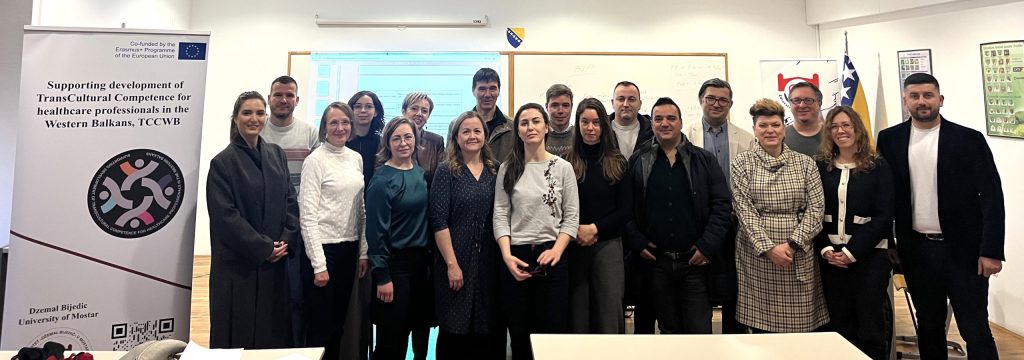
In Mostar in December 2025, the project consortium presented the overall project, the content of the transcultural competence program, the simulation scenarios, and the results from the first piloted educational program. The audience included faculty members and students from four universities in Bosnia and Herzegovina and two universities in Albania, as well as healthcare professionals from Mostar.
From awareness to action: What the workshops really changed
The impact of the workshops was examined through both structured assessment and participant feedback, offering a nuanced picture of how cultural competence develops in short, intensive learning formats. Trainers’ cultural competence was measured before and after the workshops at several measuring points using an established assessment instrument Cultural Competence Assessment (CCA) tool (Schim et al., 2003; Doorenbos et al. 2005). As expected, brief one‑ or two‑day interventions did not lead to measurable shifts in cultural awareness or sensitivity, dimensions that typically evolve over longer periods of reflection and experience (Urgund et al. 2025).
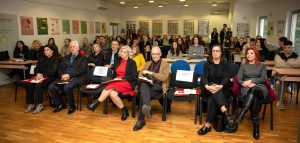
Audience listening at the workshop presentations in Mostar. Photo: TCCWB project.
What did change, however, was cultural competence behavior. Across the workshops held in Sarajevo and Mostar, trainers reported clear improvements in how they act in culturally diverse situations. This finding is particularly significant: it suggests that even short educational interventions can strengthen practical, observable aspects of cultural competence, translating knowledge into action rather than remaining at the level of attitudes alone.
Satisfaction with the workshops was consistently high, with overall quality ratings ranging from 8,1 to 9,6 on a ten‑point scale. Written feedback echoed these scores, emphasizing the relevance, clarity and applicability of the content.
Taken together, the findings underline an important point for educators and program designers: while deep attitudinal change takes time, well‑designed workshops can effectively enhance culturally responsive practice and leave participants both satisfied and motivated.
New teaching materials for partner universities
The results also showed that the respondents didn’t always have resource books or other materials available to learn about cultural aspects. To address this need, the teaching content and study plan for the transcultural competence program were translated into Albanian, Bosnian, and Serbian; the native languages of the partner institutions.
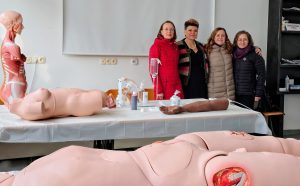
Anatomical models, task trainers, and simulation mannequins help nursing students in learning new skills. Photo: Saara Laaksonen.
This capacity‑building project enabled all five partner universities to acquire new teaching materials for both simulation‑based and digital learning. In Mostar, we were able to see the newly purchased equipment fresh out of their packages and ready for use. In one of the planned simulation scenarios, a dark‑skinned practice arm was used to perform invasive procedures on a simulated immigrant patient in the emergency department. Capacity building in the form of new teaching materials on display. Anatomical models, task trainers, and simulation mannequin help nursing students to learn new skills.
Our own cultural competence development during the project
Open dialogue and time spent together with project partners helped us reflect on our own assumptions and strengthen cultural competence. We learned about the issues affecting the lives of people in the Western Balkans. We found out how the people living there are trying to build a common national identity after the war, despite the differences in religion, language and culture. We also learned a lot about the challenges they face in healthcare. This is because so many refugees are passing through their countries on their way to Europe.
In addition, we gained understanding of the differences in pedagogical cultures. We learned that even a concept such as workshop can mean different things to people from different countries. For our partners, workshops meant lectures given by specialists and time for comments, questions, and answers. We thought we would work together with topics and co-create content. After all we managed to reach our project goals with different pedagogical orientations.
This project brought together experts from four countries and seven higher education institutions, representing a wide range of backgrounds and expertise. Although not all participants were nursing professionals, everyone shared a commitment to developing cultural competence. Bringing together experts from different backgrounds is always enriching, as it broadens understanding and expands professional networks. Looking ahead, these networks and connections are particularly important, as future research, development and innovation projects in healthcare require diverse expertise, including in the development of healthcare services.
References
Doorenbos, A. Z., Schim, S. M., Benkert, R., & Borse, N. N. (2005). Psychometric evaluation of the Cultural Competence Assessment Instrument among health care providers. Nursing Research, 54, 324–331. PMID: 16224318
Schim, S. M., Doorenbos, A. Z., Miller, J., & Benkert, R. (2003). Development of a cultural competence assessment instrument. Journal of Nursing Measurement, 11(1), 29–40. PMID: 15132010
Urgun, D. U., Seidel, J. S., Vangeli, E. V., Borges, M. B., & de Oliveira, R. F. (2025). Exploring the impact of cross-cultural training on cultural competence and cultural intelligence: A narrative systematic literature review. Frontiers in Psychology, 16. https://doi.org/10.3389/fpsyg.2025.1511788
TCCWB – Supporting Development of TransCultural Competence for Healthcare Professionals in the Western Balkans
Aim of the project is to develop and pilot a new study program focused on transcultural competence in nursing for beneficiary HEIs in Albania and Bosnia and Herzegovina. The duration of the project is 1.4.2024.–31.3.2027.
More information on webpage: https://tccwb.unze.ba/
TUAS research group: Developing Better Health Care in the Hybrid World